Probabilistic predictability paper
DRPP answers "what can a predictor guarantee when the model is uncertain?" — a lower bound. This page is the other side: "how well could anything predict this system, if the system were known exactly?" — an upper bound. Together they bracket what prediction can do, and the gap between them is what your model uncertainty is costing you.
The question the paper asks
A probabilistic predictor is judged by a scoring rule. The celebrated logarithm score is proper,
but it is fragile for multimodal or sparse predictions: a pdf being large at one point does not
mean much probability sits around it, and a pmf with finite support scores -inf almost everywhere.
The paper asks what happens if the score looks at a neighbourhood of radius epsilon instead of
a point, and what that implies for how predictable a system is at all.
The three results
- An
epsilon-logarithm score that generalises the logarithm score and is finite for sparse predictions. It reduces to the logarithm score atepsilon = 0— discontinuously, as explained below. - A closed-form predictability bound,
d log(2 epsilon) - h_d(q): the best expected score any predictor could achieve on a system known exactly, determined by the radius, the differential entropy of the process noise, and the state dimension. No predictor is involved in computing it. - An
O(epsilon)approximation for the expected score of any given predictor, plus a single-trajectory result: under i.i.d. process noise the time-averaged score converges to the expectation, at rate \(O(T^{-1/2})\) in probability.
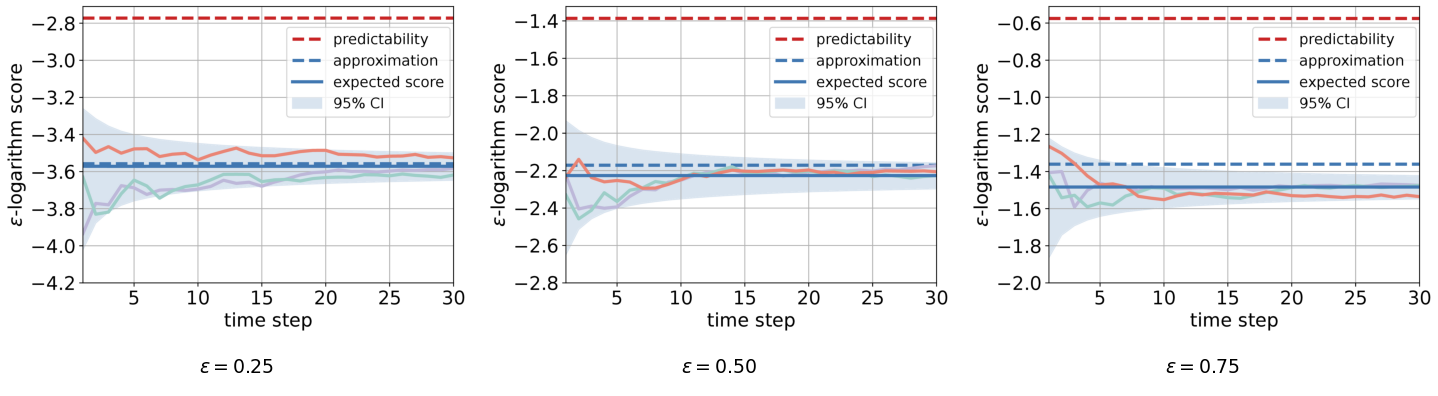
The figure below is the paper's own, across three radii. The site reproduces it from code:
- The example: six golden values you can check by hand
- The experiment: the same figure over 100,000 trajectories
- The other paper: conic-moment DRPP
A score that looks at a neighbourhood
The ordinary logarithm score evaluates a predictive distribution at the exact outcome:
That one number is fragile in a specific way: it is -inf the moment the outcome lands anywhere
your prediction put zero probability, and for a prediction with sparse support — a pmf with a
handful of atoms — that is almost every outcome. The epsilon-logarithm score replaces the point
with a neighbourhood:
The score is now the log of the probability near what happened, which is finite for a sparse
prediction and reduces to the ordinary logarithm score when eps = 0.
The score is discontinuous at
eps = 0. At exactly zero it islog p(x); for anyeps > 0the neighbourhood integral is roughly(2 eps)^d * p(x), so the score carries ad * log(2 eps)penalty and runs to-infasepsshrinks. The ordinary logarithm score is recovered by subtracting that term, not by taking a limit. This is a property of the definition, not a numerical artefact.
Predictability is an upper bound, and it needs no predictor
Maximise that score's expectation over every admissible predictive distribution and you get a number that describes the system, not any method — the probabilistic predictability:
where d is the state dimension and h_d(q) is the differential entropy of the true one-step
distribution. Nothing about a predictor appears: this is the best expected score achievable, full
stop.
For a given predictor p, the same theorem gives an approximation to its expected score, with
an error of order eps:
That is the line a continuous predictor's measured score converges to. It does not exist for a
pmf predictor: an atom law has no density, so H(q || p) is infinite and there is nothing to
plot. For those, the upper bound is the only reference there is.
from ppsds.numerics.random_variables import multivariate_uniform
from ppsds.predictability.bounds import approximation_value, predictability_upper_bound
from ppsds.predictability.entropy import cross_entropy, differential_entropy
from scipy.stats import multivariate_normal

noise = multivariate_uniform(low=-np.ones(2), high=np.ones(2))     # the true process noise
predictor = multivariate_normal(mean=np.zeros(2), cov=np.eye(2))   # some predictor's law

predictability_upper_bound(noise, eps=0.5)          # the best anyone could do
approximation_value(noise, predictor, eps=0.5)      # where this predictor should land
This package does not ship a predictor that attains the upper bound. The bound is here to be measured against — it tells you how much room is left, and it is the honest reference line for any predictor you bring, including one you wrote yourself.
One trajectory is enough
The expectation above is over trajectories, and averaging over many of them is the obvious way to
estimate it. It is also unnecessary. For a system whose process noise is i.i.d., the score on a
single trajectory, averaged over its own steps, converges to the expected score — at rate
O(T ** -0.5) in probability:
from ppsds.predictability.trajectory import across_trajectories, cumulative_average

# scores is (n_traj, T): one epsilon-logarithm score per step per trajectory
running = cumulative_average(scores)          # each row becomes its own running average
band = across_trajectories(running)           # mean and 2.5% / 97.5% across trajectories
So a handful of curves is a legitimate estimate, and a single long rollout is a legitimate measurement. That is why the figures for this need no repeated sampling — and why the score you watch accumulate step by step is not a noisy stand-in for the real number, it is the real number converging.
Evaluating your own predictor
Any predictive law works, as long as it can integrate over a box:
| what you have | what to provide |
|---|---|
a scipy.stats distribution |
nothing — the score integrates through its CDF |
| a diagonal Gaussian | nothing — a closed form is used, which is what makes large sweeps cheap |
| a pmf / atom law | the law object, e.g. ppsds.numerics.atom_pmf.AtomPmf |
| anything else | a box_integral(x, eps) method returning the probability inside the box |
from ppsds.scoring_rule.epsilon_logarithm_score import EpsilonLogarithmScore

scorer = EpsilonLogarithmScore(eps=0.5)
scorer(my_predictive_law, x)            # one outcome
scorer(my_predictive_law, outcomes)     # or a batch, shape (n, d)
A predictor that puts no probability within eps of what happened scores -inf. That is the
correct settlement, not an error.
Where this sits relative to DRPP
- Predictability — the best expected score for a system known exactly. An upper bound, and a property of the system.
- DRPP — the score a predictor can guarantee for a system known only through an ambiguity set. A lower bound, and a property of the predictor.
They are not the same pair as value_upper_bound_true_transition() /
value_lower_bound_eigvec_fixed(), which bracket the relaxation gap inside one ambiguity set.
See Preliminaries for how the two pairs fit together.
Next
- Feel the ceiling: the betting game measures its bets against exactly this number
- Check the numbers by hand: the predictability example prints the golden values
- Reproduce the figure: the predictability experiment
- The other bound: conic-moment DRPP — what a predictor can guarantee when the system is not known exactly
- Score your own predictor against it: API reference for
predictability_upper_boundandapproximation_value
Citation
@article{xuProbabilisticPredictability,
  title   = {Probabilistic Predictability of Stochastic Dynamical Systems},
  author  = {Xu, Tao and Li, Yushan and He, Jianping},
  journal = {Automatica},
  volume  = {174},
  number  = {112160},
  year    = {2025},
  doi     = {10.1016/j.automatica.2025.112160}
}