ppsds: probabilistic prediction for stochastic dynamical systems
How probabilistically predictable is a system you only partly know? ppsds answers from both
sides: the ceiling any probabilistic prediction could reach on a system you know exactly, and a
probabilistic predictor that comes with a floor over every system you are willing to admit.
If that sounds abstract, that is expected. The paragraph above is written for readers who already know what a stochastic dynamical system is and what probabilistic prediction means. Many people have never met either term, and some may already be working with such a system without knowing it. You cannot miss a capability you have never had a name for. The one-minute game below replaces the vocabulary with something you can play: place a few bets, watch the system move, and see what a probabilistic prediction is before reading a definition of it.
| on screen | in ppsds |
|---|---|
| the moving puck | the system — a drift plus a known noise law |
| the stacks you place | the probabilistic predictor — a probability mass function (pmf) over where the puck will be |
| how they pay | the scoring rule — the epsilon-logarithm score |
A puck moves around a table. You bet on where it will land next by placing stacks. Then the dealer
drops a ball: every stack within epsilon of the landing pays its share of your bet. That is the
whole idea with the abstraction removed; the table above maps the three things on screen onto the
three things the package is made of. Thirty seconds on the table explains what the package is
better than a paragraph can — no install, no server, nothing kept.
The rules, and why they are the package
Bet by placing stacks; a stack is one atom of a pmf and its height is the weight. The dealer
drops a ball, every stack within epsilon of the landing pays its share, and your round is
scored by the epsilon-logarithm score — the log of the probability you gave the landing's
neighbourhood. Cover the table builds the safe layout: it tiles the noise support, so it
pays the same share every round and cannot lose — at the price of never winning big. A run
ends when a round pays nothing, or when you ask it to.
When you want the same thing done rigorously, the bets you place export to a file the betting experiment reads back and recomputes round by round.
Install
pip install ppsds
0.0.3-alpha is a pre-release: pin it with pip install ppsds==0.0.3a0, or pass --pre. Plain
pip install ppsds selects it while no stable version exists; once 0.1.0 is out, plain install
selects the stable release.
Core dependencies are numpy, scipy, cvxpy and gymnasium; Python 3.10 or newer. Only the
experiment and plotting periphery needs more:
pip install "ppsds[experiments]" # adds matplotlib, pandas, seaborn, tqdm
Each example and experiment directory also carries its own environment.yml if you would rather
create a conda environment for exactly one page.
Get started
Rows are how far you want to go. Columns are what you start from, ordered from nothing to data without a model.
| From → | A · Just curious Nothing yet. |
B · Build it yourself No environment. |
C · Your system You can step it. |
D · Data only No model or env. |
|---|---|---|---|---|
| L0 · See | 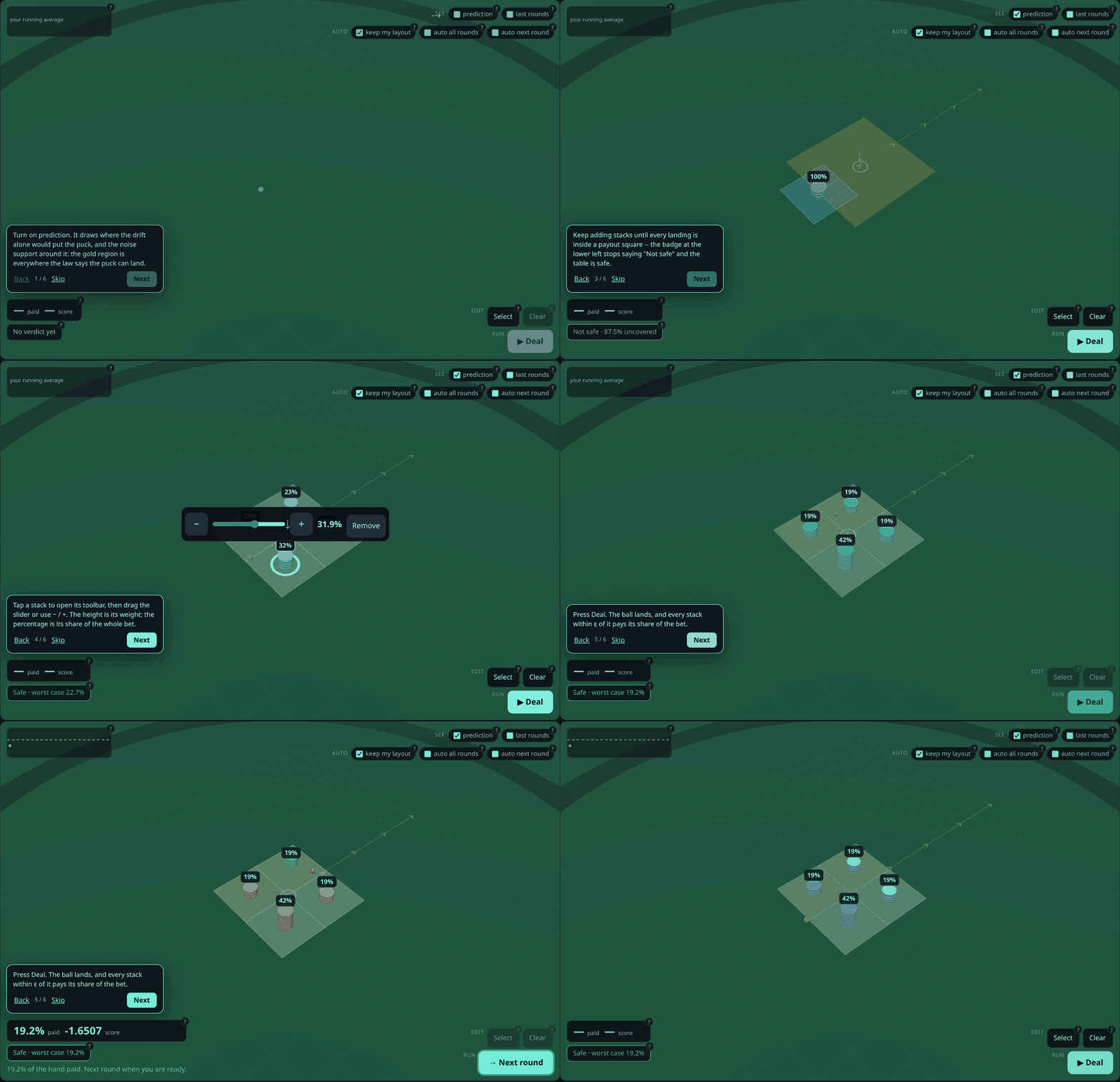 Just curious: see what a probabilistic prediction is in one minute. |
— | — | — |
| L1 · Use | — | 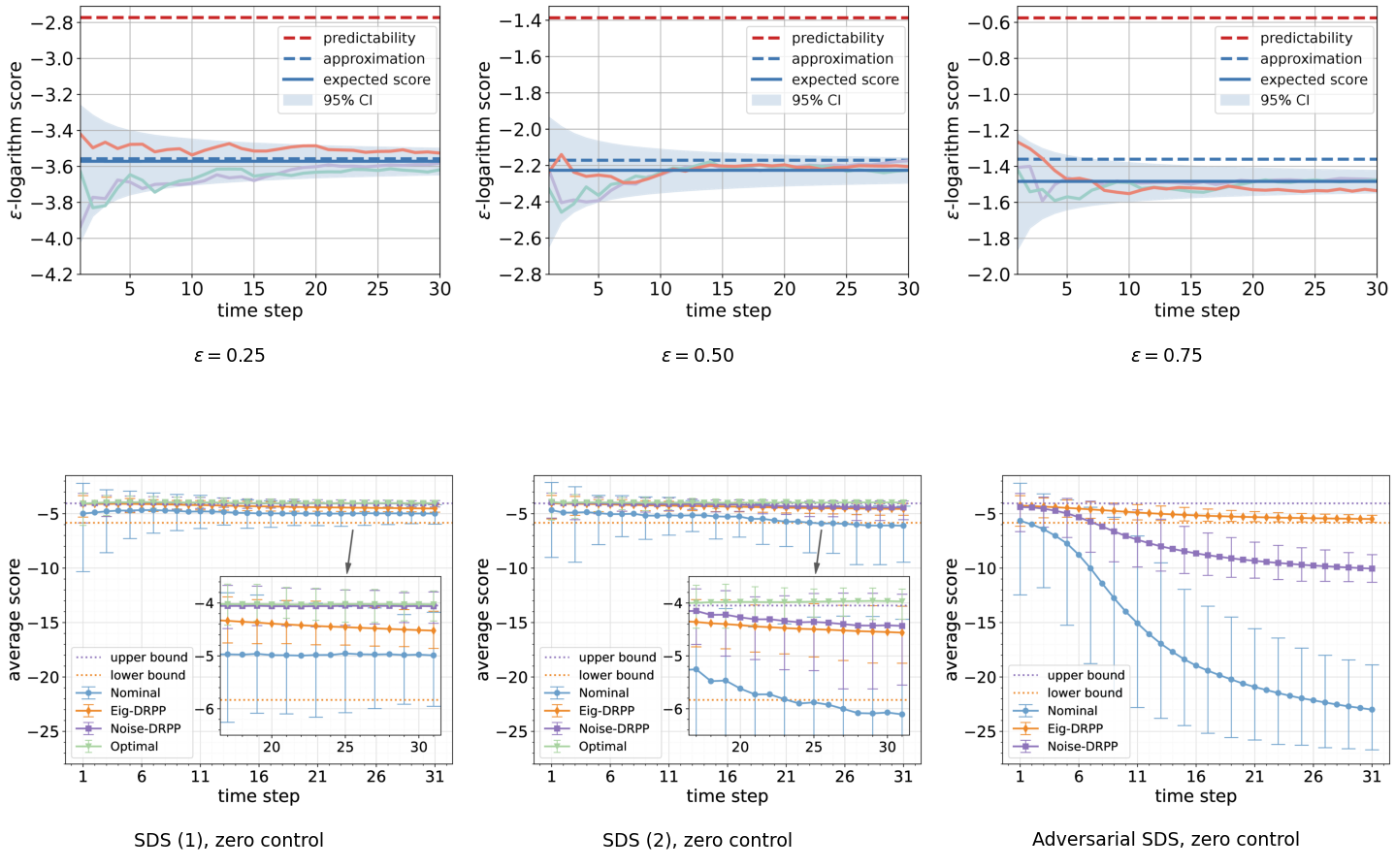 Reproduce a paper: build the system from the paper and check its figures. |
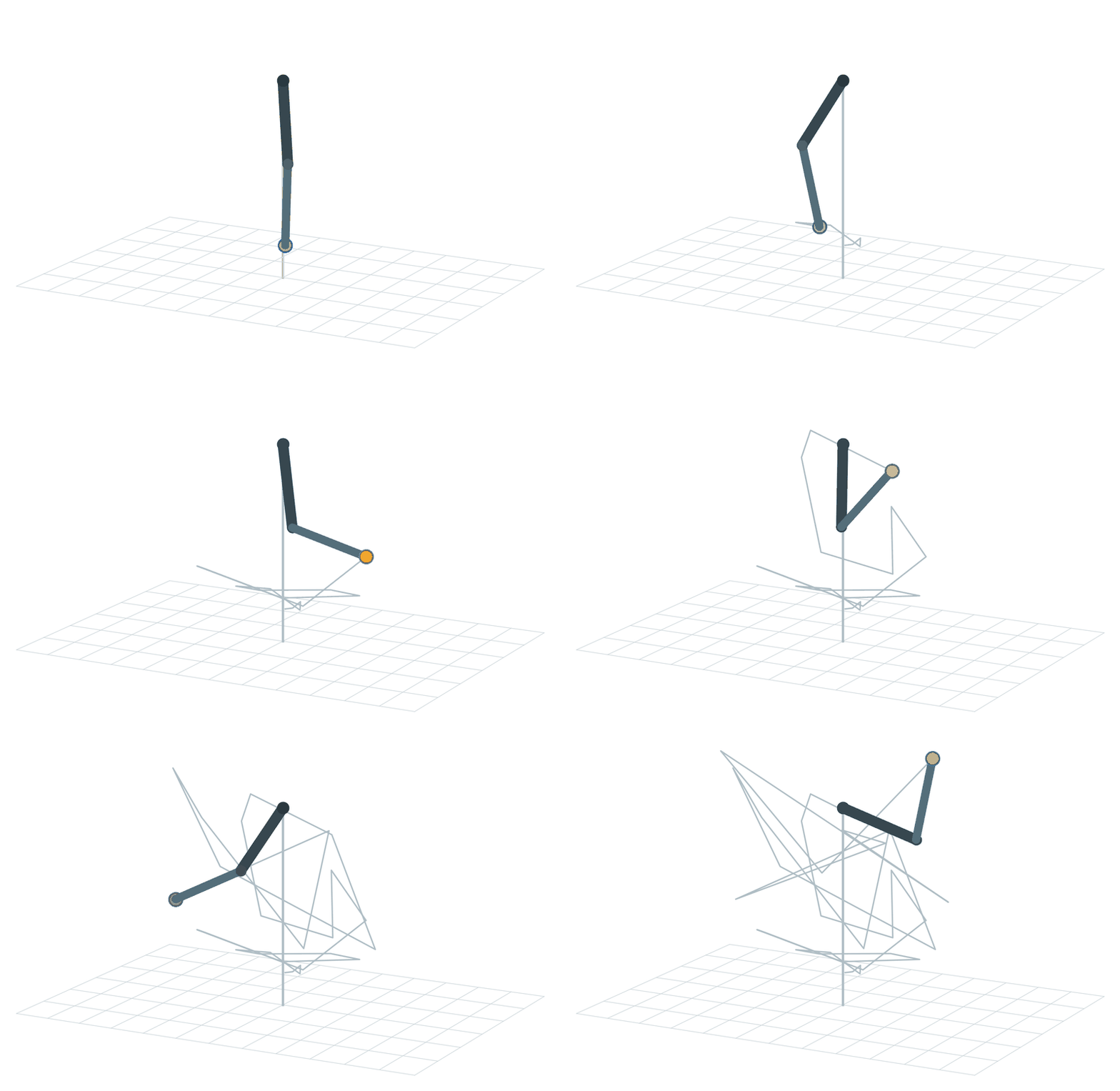 Use it on your system: put a predictor on a Gymnasium environment you already have. |
Only data: you need a system you can step; read the limits first. |
| L2 · Extend | — | Add a predictor kind: try a different prediction law in a simulation you build. | 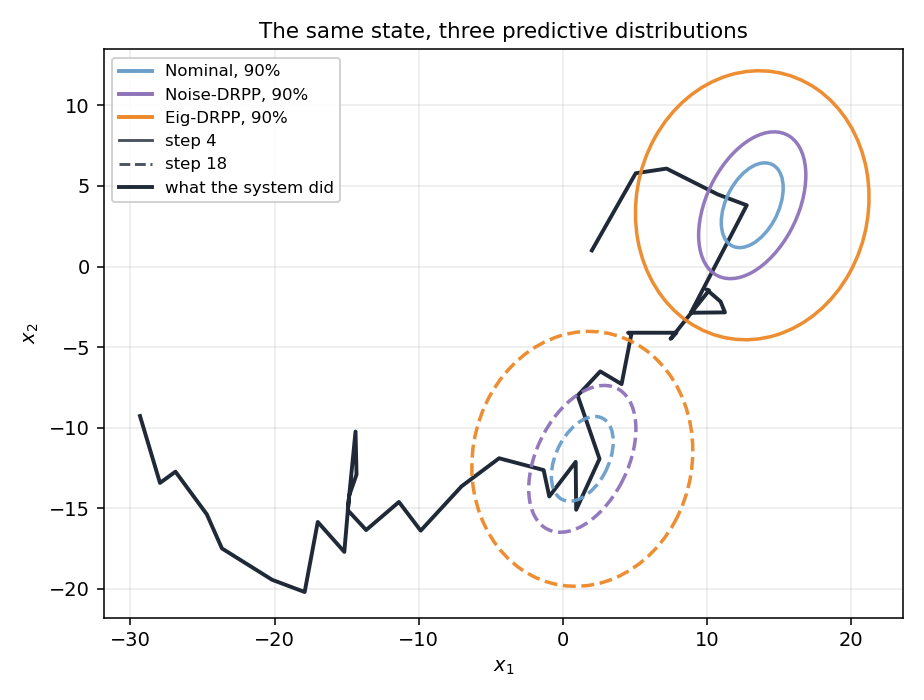 Add a family: teach the library the uncertainty language your system needs. |
— |
| L3 · Research | — | Work on the ceiling: scoring rules, predictability, and what no predictor can beat. | Do research on the floor: change the assumptions, not just the implementation. | — |
| L4 · Contribute | Found a problem while playing: open an issue; the game is a real user of the library. | Contribute what you built: file an L1 issue, or send an L2/L3 result (including a benchmark) as a pull request. | Contribute what you built: file an L1 issue, or send your L2/L3 results as a pull request. | Discuss a research collaboration: this column is future research; L0–L3 are blank here. |
Recommended routes
The table above sells one story at a time. These are the routes — paths that cross the site's four sections, for a reader who knows what they are trying to get done.
Need the panorama? The map below shows every route at a glance; the map page explains what each one means and how the sections connect.
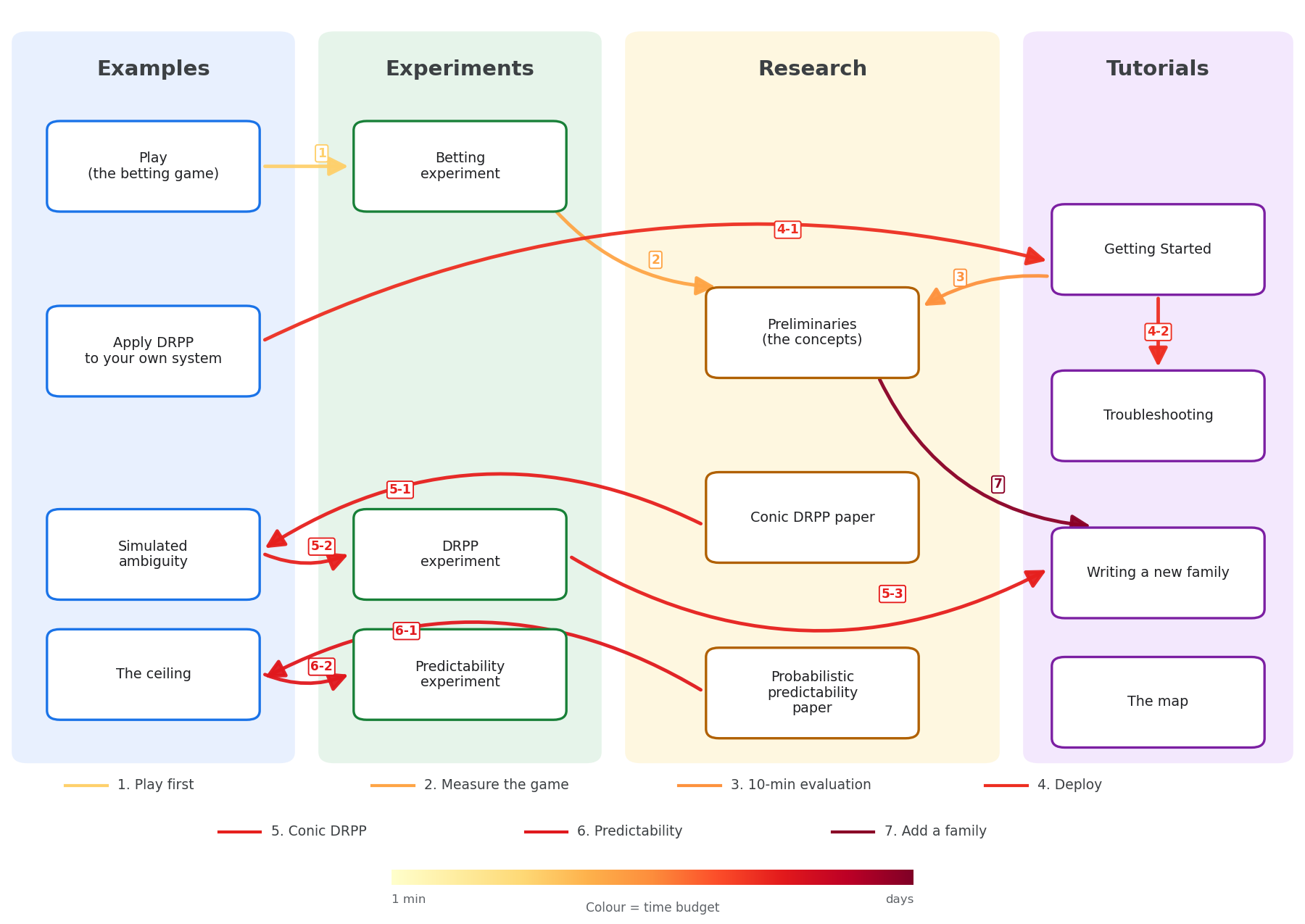
1 · Play first. The game needs nothing installed. Thirty seconds on the table, and you know what a probabilistic prediction is.
2 · Measure the game properly. The game → the betting experiment → Preliminaries. The same move over thousands of trajectories, against the ceiling.
3 · The 10-minute evaluation. The apply quickstart → the honest limits. Run one script, read what the guarantee does not cover, and decide whether to try it.
4 · Deploy on your own system. Apply DRPP → Getting Started → Troubleshooting. The four-step declaration, the pitfalls, and the two ways it surprises you.
5 · Check or reproduce the conic DRPP paper. The paper → the simulated-ambiguity example → the DRPP experiment → A new family and its DRPP.
6 · Check or reproduce the probabilistic predictability paper. The paper → the ceiling example → the predictability experiment.
7 · Do research, or add a family. Preliminaries → either paper → A new family and its DRPP → CONTRIBUTING.
Sections on this site
| Section | What it is |
|---|---|
| Examples | Four stories you can run. Each prints every number it talks about; no batch infrastructure required |
| Experiments | The same questions at paper scale: cached, parallel, reproducible, with the figures the papers report |
| Research | The common preliminaries, and one page per paper with its result, its figure, its experiment links, and its citation |
| Tutorials | Topics treated on their own terms — Getting Started, A new family and its DRPP, Troubleshooting, and the map |
| API | Generated from the docstrings, so it cannot drift from the code |
A little more about what is inside
ppsds predicts the next state of a stochastic dynamical system as a distribution rather
than a point. It is for systems you can step (a simulator, or a Gymnasium environment) and
can model, but not exactly: an underactuated robot, a vehicle or drone held near its operating
point, a plant inside a process simulator.
An ordinary predictor trusts that model. That works until the real system drifts away from it, and then the prediction is quietly too narrow: overconfident exactly when you needed it to be honest.
ppsds ships one remedy today: DRPP, distributionally robust probabilistic prediction. You
declare an ambiguity set — the systems you are willing to admit — and DRPP returns the
predictive distribution whose worst-case expected score over that set is as high as it can
be: a floor that holds for every system in the set, for the price of a little average
performance.
That DRPP is the one for conic-moment ambiguity sets, on an additive-drift system. It
is the first of a template rather than a single method: each family of ambiguity sets yields
its own DRPP, and the drpp subpackage is built to hold more. Zoom out one level and DRPP is
one kind of probabilistic predictor;
probabilistic predictability answers the same
question from the other side, for a system you do know exactly.
Citation and licence
If you use ppsds, cite the software:
@software{ppsds,
  title   = {ppsds: probabilistic prediction for stochastic dynamical systems},
  author  = {Xu, Tao and He, Jianping},
  license = {MIT},
  url     = {https://github.com/Xuzerken/ppsds}
}
GitHub's Cite this repository button reads
CITATION.cff and produces the same
entry; an archived release with a DOI will be added once the first stable release is archived. Each paper's
citation is at the end of its page: conic DRPP paper and
probabilistic predictability paper.
ppsds is MIT licensed: use it freely, keep the copyright and licence notice. If you want to
contribute, CONTRIBUTING has the
setup, the tests, and the rule that a change must not move a number.
Next
- Thirty seconds, no install: play the betting game
- You have an environment: Getting Started puts a predictor on it
- You want the theory: Research, then the two papers
- You want the graph: the map