Two papers accepted to the 65th IEEE Conference on Decision and Control (CDC 2026)
Two papers were accepted to the 65th IEEE Conference on Decision and Control (CDC 2026):
- Decision-Aware Learning for Context-Dependent LQR: A Smart Predict-then-Optimize Approach
- High-Efficiency Distributed Nonconvex Optimization Design with Certified Stopping Rule
Congratulations to Ling Yao and Wenxiao Du!
Related publications
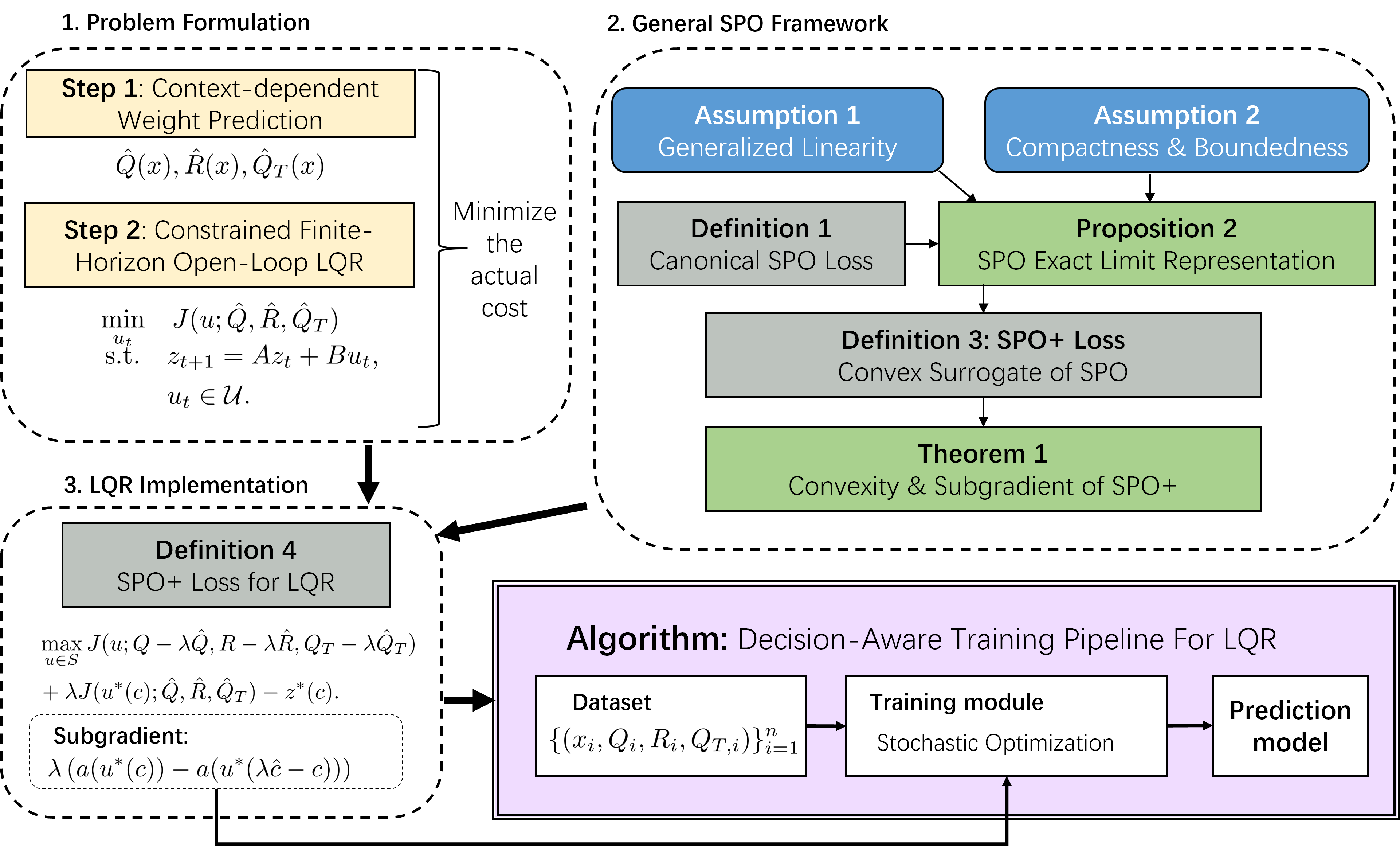
Decision-Aware Learning for Context-Dependent LQR: A Smart Predict-then-Optimize Approach
IEEE 65th Conference on Decision and Control (CDC)
TL;DR A smart predict-then-optimize approach that learns predictions tailored to downstream context-dependent LQR decisions.
Abstract & PDF
This paper develops a decision-aware learning framework for constrained linear quadratic regulator (LQR) design. It addresses the challenge of tuning unknown context-dependent cost weighting matrices by directly optimizing downstream control performance. When the prediction accuracy is poor, traditional two-stage methods, separating weight prediction and control optimization, are difficult to meet the demands of downstream high-precision tasks. Thus, we introduce the Smart Predict-then-Optimize (SPO) framework to the constrained LQR problem, which optimizes downstream control quality via direct decision regret minimization. First, we generalize the theory of the SPO framework to fit the LQR control problem. Second, we derive a convex surrogate for SPO loss, which retains interpretability via explicit weight prediction. Third, we propose an end-to-end training pipeline based on gradient-based optimization. Finally, we validate our approach via simulations, showing that our method reduces the cost ratio by approximately 34% compared to the Mean Squared Error (MSE) baseline, achieving significantly better downstream control performance.
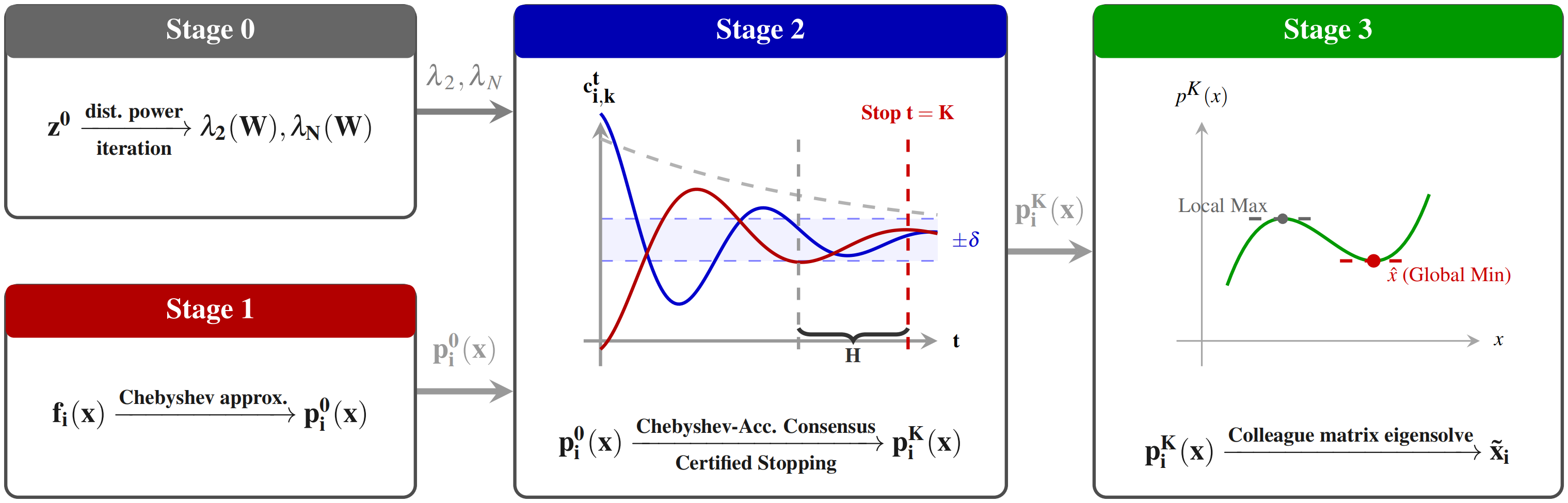
High-Efficiency Distributed Nonconvex Optimization Design with Certified Stopping Rule
IEEE 65th Conference on Decision and Control (CDC)
TL;DR A high-efficiency distributed nonconvex optimization method with a certified stopping rule.
Abstract & PDF
Distributed nonconvex optimization with certification constraints is a crucial demand in multi-agent networks, especially sparse ones. However, a globally suboptimal consensus value may invalidate stability or safety requirements. To address this issue, we develop a Chebyshev-Accelerated Surrogate Optimization (CASO) pipeline for distributed optimization of univariate objectives. CASO consists of four stages: distributed power iteration, local surrogate construction, accelerated coefficient consensus and algebraic global minimization of the final surrogate. With a distributedly verifiable stopping rule, CASO provides an -global optimality guarantee, and reduces communication costs across sparse networks. Simulations verify the theoretical rigor and methodology effectiveness of CASO.